Sunday, March 5, 2023

2023 SDG National Partnership Workshop

It was a great exposure and learning for many advocates like us. More than 50 organisations are invited to attend this workshop on 4-5 March 2023 to build a relationship / partnership with each other with similar goals to support the achieve of the Sustainable Development Goals (SDG). At this workshop, representatives of organisations have the chance to meet with other passionate leaders and learn about how to join forces effectively with MySDG Academy and Persatuan Promosi Matlamat Pembangunan Lestari to help empower youth in our communities and localize the SDGs.


After this workshop, we will continue to nurture the partnership which is created during and after the workshop so that we could grow stronger together. However, we would definitely need your continuous support and participation in our various programme in future. We hope those programme will benefit every Deaf person in many ways that we could think of.

----------

Ia merupakan pendedahan dan pembelajaran yang hebat untuk ramai advokasi seperti kami. Lebih daripada 50 organisasi dijemput menghadiri bengkel ini pada 4-5 Mac 2023 untuk membina hubungan / perkongsian antara satu sama lain dengan matlamat yang sama untuk menyokong pencapaian Matlamat Pembangunan Lestari (SDG). Pada bengkel ini, wakil organisasi berpeluang bertemu dengan pemimpin lain yang bersemangat dan belajar tentang cara bergabung tenaga secara berkesan dengan Akademi MySDG dan Persatuan Promosi Matlamat Pembangunan Lestari untuk membantu memperkasakan belia dalam komuniti kita dan menyetempatkan SDG.

Selepas bengkel ini, kami akan terus memupuk perkongsian yang diwujudkan semasa dan selepas bengkel supaya kami dapat bertambah kukuh bersama. Walau bagaimanapun, kami pasti memerlukan sokongan berterusan dan penyertaan anda dalam pelbagai program kami pada masa hadapan. Kami berharap program tersebut akan memberi manfaat kepada setiap orang Pekak dalam pelbagai cara yang boleh kami fikirkan.


Friday, December 9, 2022

He's deaf but that doesn't stop him from achieving his goals


It's not always easy to order a drink at the cafe when you're deaf, says Anthony Chong.


Dr Anthony Chong, 40, was born deaf, but he’s never let it stop him from pursuing his dreams.

Chong, the third of four children, says he is grateful to his dad Chong Kek Kong, a bus driver and mum Lai Yook Chin, a hawker, for supporting him in his studies.

“My parents encouraged me to master Bahasa Malaysia because they believed this would help me succeed in the future.

“They were very supportive of my education,” says Chong who is Universiti Malaya’s first deaf PhD recipient.

His parents also taught him about responsibility. From the young age of seven, Chong started helping his mother with house chores.

“I did the laundry for the whole family, washed and ironed the clothes, and did the dishes too, as well as other household chores,” he says.

He also watched a lot of dramas on television and read subtitles to improve his command of BM.

Anthony Chong uses BIM (Malaysian Sign Language) to communicate. This means 'applause'.


Chong didn’t have the chance to attend kindergarten because there weren’t any that could accommodate a deaf student back then.

He started his formal education in primary school in a special class. Because of the special education system, he had to spend eight years in primary school. But Chong found that he could easily ace his exams and he scored straight As.

When he went to secondary school, he was once again placed in a class for special students.

“I wasn’t learning much and wrote to the teachers, requesting that they teach us more and give us more homework.

“That made my classmates unhappy as they couldn’t cope with the extra work,” he says.

The teacher then asked Chong if he wanted to transfer to a mainstream class. With his parents’ consent, he went to a Form One class with 40 hearing students.

Chong shocked everyone when he scored first place in class, although he admits it wasn’t easy.

“I couldn’t really understand the lessons taught by the teachers, regardless of how much I paid attention in class.

“I tried my best to understand what was going on, relying on information written on the blackboard, my classmates’ notebooks, but it was very difficult,” he says, adding that he didn’t take any tuition after school but self-studied.

He scored 8As in the Sijil Pelajaran Malaysia (SPM) examination, earning him a scholarship to study at KDU College where he completed his A-levels and Bachelor of Science degree.

Communication challenges

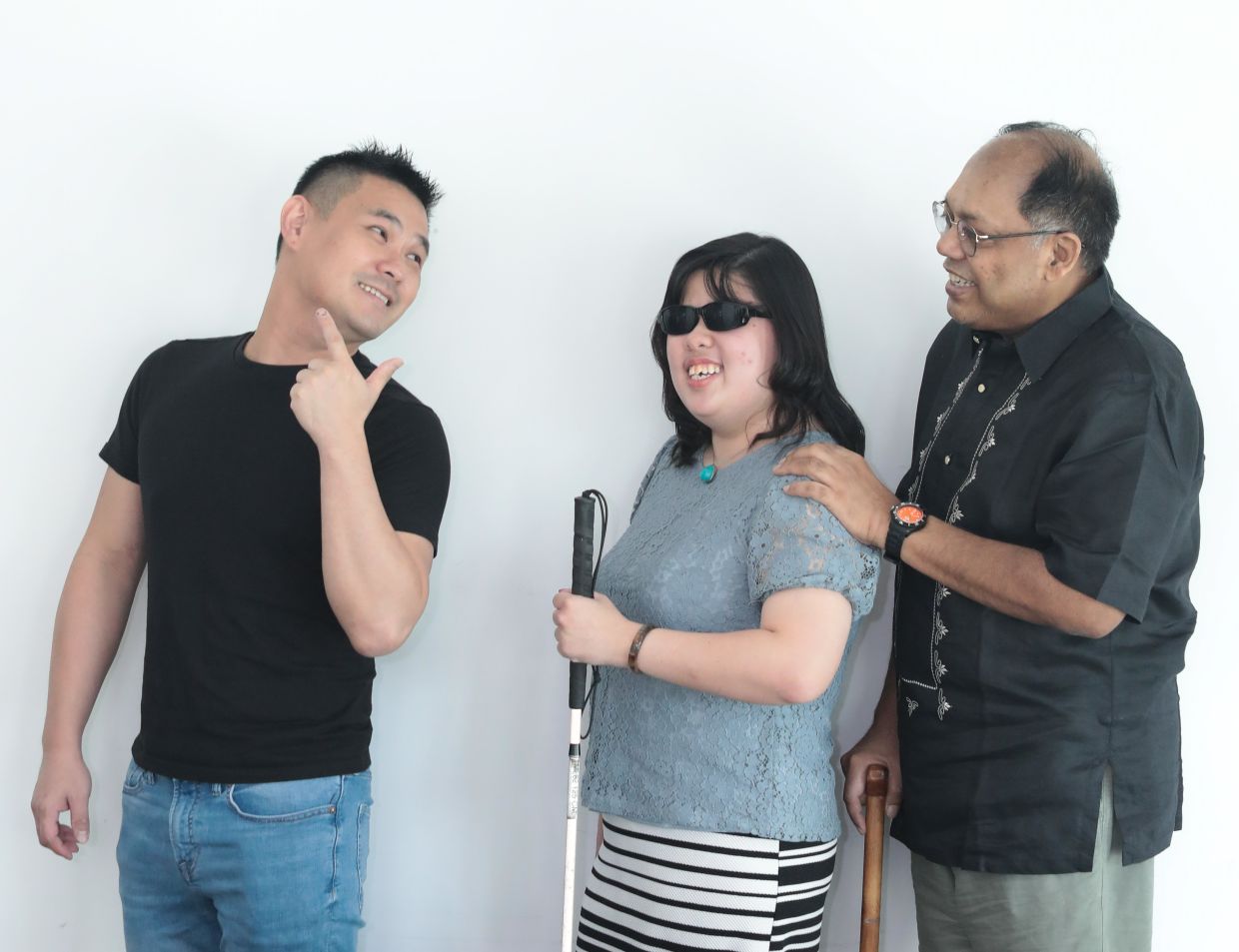
Anthony Chong (first from left) says 'smile' in BIM.


Chong notes that there is often confusion on the terms used to describe deafness.

“Those like myself who have never experienced hearing are considered deaf. We don’t have hearing loss because we’ve never heard anything from birth. It’s important to use the correct terminology because both would have very different experiences.

“Those who have hearing loss would be able to speak since they acquired this skill earlier. Those who have deafness might find this difficult,” he explains.

He adds that the deaf community actually prefer to be referred to as “deaf” rather than “hearing impaired” which signifies a lack or something negative.

One of the challenges Chong has faced is communication.

“Hearing aids can’t help me. On many occasions, I would be the last to know whatever was going on in the family or with friends and I usually don’t get all the details,” he shares.

“For example, I would be with two hearing friends and they would be talking for two hours, but I only had three sentences to explain what they talked about in the two hours. It doesn’t seem fair but this is what I’ve faced.”

For this reason, many deaf people prefer spending time with deaf friends, or at least those who know Malaysian Sign Language (BIM), he says.

Communication was also an issue when he enrolled for his Master’s degree at UM.

“I asked the university to provide BIM interpreting services for all my classes or else I was going to seek permission for waivers, so I didn’t have to attend classes.

“I would not be able to follow the teachers’ and students’ discussions and would rather stay home to study on my own,” he says.

So the university provided BIM interpreting services.

After submitting his thesis at UM, Chong flew to Washington DC in the United States to do (another) Master’s degree at Gallaudet University (a university for the deaf) on a scholarship.

“I felt overwhelmed! In classrooms with both deaf and hearing students, everyone signed fluently. It felt fantastic!” he enthused, even though he had to learn American Sign Language.

Chong is currently working as an administrative officer for a company where his main tasks are researching, developing and advising on IT-based solutions. He also consults part time for a private university on deaf accessibility to healthcare.

He spends a lot of his time advocating for the deaf community. In 2014, Chong co-founded the Malaysian Sign Language and Deaf Studies Association (MyBIM), to further develop the usage of BIM by both the deaf and hearing public.

Struggles of the deaf

Chong says that the deaf face many challenges in communicating with hearing people.

The challenges in communicating with hearing people can be very hard to bear at times, he admits.

“At a restaurant with friends, waiters tend to ignore me and go straight to hearing people. It can be very insulting. Nobody bothers to understand how the deaf person feels. It’s as if the deaf are not seen as equals with those who are able to hear,” he says.

The deaf also face challenges in the attitudes and mindsets of hearing people.

In 2016, when Chong went to a bank to apply for a credit card, he was turned down despite meeting all the requirements. When he asked for an explanation, they replied that it was because he’s a deaf person.

“It was an obvious act of discrimination and I posted about the incident on my social media. Finally, they approved my application,” he says.

“Unless the mindsets and attitudes of hearing people change and they become more aware, the deaf will always face such issues,” concludes Chong.


By MING TEOH
Photos By YAP CHEE HONG
Friday, 09 Dec 2022

Sunday, February 20, 2022

Society urges media, public to use term ‘deaf’ instead of ‘hearing-impaired’

Borneo Post Online
BY GALILEO PETINGI ON FEBRUARY 20, 2022, SUNDAY AT 6:45 PM

(from third left) Wong, Razi and Noriah in a photo call with the representatives of the associations during the Memorandum of Understanding exchange. — Photo by Galileo Petingi


KUCHING (Feb 20): The Sarawak Society for the Deaf (SSD) calls for the term ‘deaf’ instead of ‘hearing-impaired’ to be widely used by media publications and the public.

According to SSD president Albert Wong, he said the term ‘deaf’ is not a disability and they are a linguistic minority as they are still able to communicate with others using sign language.

Noticing the term ‘hearing-impaired’ was widely used in publications, he explained such a term implies someone having a disability.

Identify common problems faced by the deaf community in Sarawak

New Sarawak Tribune
Reported by: Alverdtekoster Anyap 
Date: February 20, 2022

Deaf Empowerment Workshop 2022


KUCHING: The Ministry of Women, Childhood and Community Wellbeing Development will look into the common problems faced by the deaf community in Sarawak.

Its Assistant Minister Mohammad Razi Sitam said a three-day workshop organised by the Sarawak Society for the Deaf (SSD) was to identify the issues and seek solutions.

He said the six focus areas of the discussions were education, employment, healthcare and welfare, accessibility, social recreation and culture as well as advocacy and rights.

Wednesday, February 16, 2022

BIM Poetry: Empowering Deaf Women in Malaysia Through Sign Poetry

 It is time now! Deaf women are ready to shake the world! Do not miss this opportunity. They will reveal their poetry work. It is important for the Deaf community in Malaysia. BIM poetry is part of our culture and identity. 


Date: 26 February 2022 Saturday (8.30pm - 10.30pm Malaysia time)


Surprise! 20 BIM Dictionary copies will be given away through a lucky draw! 


Registration is required: https://tinyurl.com/BIMpoetry   


This event is organised by MyBIM (Malaysian Sign Language and Deaf Studies Association) and supported by British Council. 


#BritishCouncilCTC #ConnectionsThroughCulture #CultureConnectsUs 


Thursday, December 23, 2021

Deaf activist Dr Anthony Alexander Chong outlines plans for literary workshop that highlights Bahasa Isyarat Malaysia

He's also one of the 11 beneficiaries of this year’s Krishen Jit Fund.

23 December 2021 - 10:37am


Supported by Astro and the Creador Foundation, the fund — of which Chong is one of 11 beneficiaries this year — is inspired by the late theatre director’s pioneering work in celebrating original Malaysian creativity (All photos: Anthony Alexander Chong)


It was while setting up the interview with deaf activist Dr Anthony Alexander Chong that it occurred how much we take for granted, and how mortifyingly unaware we are about the daily minutiae that can be difficult for people who are hearing-impaired. Chong is exceptionally gracious about it all, but the effect of that initial exchange is permanently seared in our collective consciousness: While we may acknowledge that the world can be a difficult place for the differently-abled, we really have no idea what some of their day-to-day challenges are.

In fact, Chong’s own activism work would not have been further highlighted if not for the Krishen Jit Fund, which is aimed at providing deserving arts practitioners with monetary aid to pursue projects in the arts. Supported by Astro and the Creador Foundation, the fund — of which Chong is one of 11 beneficiaries this year — is inspired by the late theatre director’s pioneering work in celebrating original Malaysian creativity in as varied and alternative ways as possible.

Monday, December 13, 2021

Queer and Deaf in ASEAN Countries

PUBLISHED ON 13 DEC 2021
POSTED BY DR. ANTHONY CHONG
POSTED ON ACTIVIST VOICES


I would like to begin with a few facts about Deaf people in Malaysia. It is already difficult to live as a Deaf person in mainstream society, as many people are ignorant about Deaf people and do not understand that we are a linguistic minority. We experience poor access to information because of the ignorance of others, not because of our deafness. We are compelled to spend time and money on speech and listening therapy, even though such therapy does not always work for many of us. Despite its futility, people around us continue to insist that we give importance to speech and listening therapy. This has caused us to lose a lot of valuable time, money and energy in fruitless efforts towards mastery of oral communication. If we could pursue self-empowerment via sign language, our natural language, we would acquire sufficient literacy skills to access information in the mass media and other sources to function better.

Our lives become complicated when we realize that we are not heterosexual. We become fearful and do not know what to do with this self-realization. We learn from the stories of others and from the movies that it is not safe to live with an LGBTIQ identity. The worst has happened to those who revealed their queer identity -- they have been forced to go through conversion therapy. We feel a little better when we find another Deaf person with LGBTIQ.

Saturday, November 27, 2021

Krishen Jit Fund 2021 doubles arts support, announces 11 beneficiaries

This year's Krishen Jit Fund featured 11 recipients (from top, left) Susan Philip, Anthony Chong, Rezza Coebar Abel, Talha K.K., Komeil Zarin, a reprentative of Syamsul Azhar, Izat Arif, Jeffrey Lim and Gogularaajan Rajendran. Photo: The Star/Ong Soon Hin

This year's Krishen Jit Fund featured 11 recipients (from top, left) Susan Philip, Anthony Chong, Rezza Coebar Abel, Talha K.K., Komeil Zarin, a reprentative of Syamsul Azhar, Izat Arif, Jeffrey Lim and Gogularaajan Rajendran. Photo: The Star/Ong Soon Hin

Gogularaajan Rajendran, a filmmaker, has always heard rich stories from his grandparents about estate life in Malaysia in the 1960s. What bothered him was the fact that he had never seen such stories depicted in local films.

“All this while, plantation stories have only been focused on the struggles of the people. But there is more to it than that. I believe we have missed out the life, joys and humour of Malaysian Indian communities who lived in the plantations. I'm curious about the many rich and nuanced stories out there. I’m planning to interview 50 people over the age of 60 from five different estates as part of a documentary film and research project for my upcoming feature film Kaali,” says Gogu, as he is fondly known.

Krishen Jit Fund awards 11 grants to 11 Malaysian artists

Some of the recipients of the Krishen Jit Fund this year

Some of the recipients of the Krishen Jit Fund this year


KUALA LUMPUR: The Krishen Jit Fund, that promotes the aspirations of promising Malaysians who thrive in the creative arts, is back and has just awarded grants to 11 individual and collective artists.

The fund, managed by Astro and the Five Arts Centre and supported by Creador Foundation, awarded RM86,000 to the artists in a ceremony held at the Five Arts Centre in Taman Tun Dr Ismail today.

The creative recipients for this year are Anthony Alexander Chong whose project is the Malaysian Sign Language literature workshop, Jeffrey Lim (Khemah Kamera), Flux28 Collective (Night Shift), Izat Arif (Hybrid Exhibition), Rezza Coebar (Earthshine), Fraulina Tajuddin (Young Kids' Web Series), Gogularaajan Rajendran (Plantation Life: As It Was), Syamsul Azhar Mohamad Azmi (Dari Pinggiran), Arief Iskandar Hamizan (Panas Play Reads), Susan Philip (The Satira Archives) and Komeil Zarin (30 Portraits In Exile).

Friday, November 5, 2021

Would you mind to use correct term please? Correct term is Jurubahasa BIM (BIM interpreter), instead of Jurubahasa Isyarat (Sign Language Interpreter).

It is really very important to use correct term. I have seen wrong terms in mass media and it will cause people think that every interpreter in Malaysia masters 200 sign languages which is not true.

Nobody here in Malaysia or other countries is expert to evaluate interpreters for 200 sign languages.

I could not understand why media keeps using this “sign language interpreter” when the term is not correct.

Government officers will not understand that Malaysian Deaf is capable to communicate in BIM only, not 200 sign languages. People misunderstand that KTBM is a sign language, which is not true too. If we keep promising “sign language interpreter”, the government will say,

Since it is “sign language”, so why not we take sign language from Japan, UK, Australia, Hong Kong for the Deaf students. All sign languages are just same thing. Everyone uses hands.

Tuesday, September 21, 2021

Celebrating Thriving Deaf Communities

Dear all friends!
 
It is our pleasure to invite you to attend a webinar Celebrating Thriving Deaf Communities, In conjunction with International Week of the Deaf People (IWDP) and International Day of Sign Languages (IDSL) 2021. It is jointly organized by three civil society organization: MyBIM, JUPEBIM and DeafMT. It will be held on 2 and 3 October 2021. The webinar will be in English and BIM.

Please mark these dates and time slots in your calendar. Please register yourself for the webinar: https://tinyurl.com/2021BIMSeminar

More details about the programme can be found in this poster (PDF). Alternatively, you may see the programme below (image).

We sincerely hope to see you there!


Sunday, August 1, 2021

Deaf UM student earns PhD

The Star 1 August 2021 by Yeung Yeu-Mynn


PEOPLE with disabilities are part of our diverse community, and just because they are different does not mean they are incapable of achieving great things – this was the message Dr Anthony Chong (pic) wanted to convey to the public during a recent email interview with StarEdu.

It is also a reality he embodies through his academic achievement as a deaf person.

Recently, the 39-year-old made waves on social media after he shared news about his latest academic milestone – he was conferred a doctoral degree (PhD) in anthropology and sociology from Universiti Malaya (UM).

Chong is the varsity’s first deaf doctorate recipient who communicates using Malaysian Sign Language (BIM) instead of speech.

While he was pleasantly surprised by the recognition, Chong was more interested in raising the awareness and changing the perspectives of society, including policymakers, government officials and hearing academicians serving the deaf community.

“I also hope that this news will encourage more deaf people to pursue a PhD regardless of their struggles,” he said, adding that nothing is impossible if one is willing to step out of one’s comfort zone.

Chong himself had experienced some of the struggles firsthand throughout his journey as a student.

He recalled urging his teachers to give his special education class a timetable on his first day in secondary school.

“Teachers just came to our class to teach whenever they had time. I realised most of us were spending time talking and idling away,” he said.

His proactive approach led to a teacher asking if he was interested in studying with his hearing peers instead, he shared.

It was an opportunity that the Selangorian seized without hesitation. He went on to stun his teachers and 40 hearing classmates when he was subsequently promoted from the 16th class to the third, where he ranked top of his class.

Chong succeeded in doing so, despite having difficulty mastering Bahasa Malaysia and the English language, and coping with communication barriers with hearing people.

“Most of my teachers were not fluent in BIM. This hindered effective communication.

“I could not grasp lessons and relied heavily on notes my deskmates shared. Communication with my hearing classmates was also limited to writing on paper,” he said.

He added that it was only when he was pursuing his Master’s degree in linguistics in UM that he received BIM interpreting services.

“These services, however, were only lecture-limited. Hence, I had to communicate with my supervisors through pen and paper,” said Chong, who received scholarships to pursue a computing degree at KDU College, as well as a Master’s degree in deaf studies focusing on cultural studies at Gallaudet University in the United States.

While he obtained a postgraduate research grant worth RM19,800 from UM, his six-year PhD journey hit a hurdle from the outset as finding a supervisor proved to be arduous.

“I had to email each lecturer. Many said they were not skilled in my area of study until I finally found Dr Rosila Bee Mohd Hussain.

“She had been supportive throughout, tirelessly pushing me and providing resources to help with my thesis writing,” he said.

He also shared that pursuing his PhD studies, while holding a full-time job as an administrative officer and being actively involved in the deaf community, could be overwhelming for him sometimes.

“It was a constant race against time. On several occasions, I would isolate myself and simply hit the books overnight.

“When I needed to complete my thesis, I set aside all prior commitments,” he said.

In his dissertation, Chong zoomed in on the construction of deaf people’s identities through intersectionality in Malaysia’s mainstream society. Through his research, he discovered that deaf Malaysians develop two identities at an intersection, contrary to previous literature.

He found that they identify as persons with disabilities due to their inability to speak society’s language, as well as develop a personalised cultural and linguistic identity as a result of their inability to master BIM.

“Interestingly, these two identities are embraced without realisation,” he said.

According to Chong, these intersectional identities occur due to societal experiences.

“If deaf people do not encounter societal barriers, they would simply be people with a diversified background. They become persons with disabilities because society places these barriers on them,” he said.

He also pointed out that it is important to use the term “BIM interpreter” in the Malaysian context, instead of “sign language interpreter”, as there are over 200 sign languages in the world.

“This is to raise awareness and eliminate misconceptions that sign language is universal,” he said, adding that British Sign Language and American Sign Language have been introduced to the education system, further widening the communication gap between the old and the younger generation of deaf people.

On what’s next for him, Chong said he looks forward to playing a part in shaping the future of the deaf community who, he said, fuels his passion to work for their betterment.

“I hope to be involved in policymaking. i would also like to conduct research projects and collaborate with universities.

“It is time to reform deaf community policies and shift misconceptions, especially those revolving around BIM,” he said.

------

Yeung, 21, a student in Selangor, is a participant of the BRATs Young Journalist Programme run by The Star’s Newspaper-in-Education (Star-NiE) team. Throughout the year-long programme, participants aged between 14 and 22 from all across the country experience life as journalists, contributing ideas, conducting interviews, and completing writing assignments. They get to earn bylines, attend workshops, and extend their social networks. To join Star-NiE’s online youth community, go to facebook.com/niebrats.

From the source: The Star.

Saturday, March 27, 2021

BIM Poetry: Deaf LGBTIQ


Deaf LGBTQ (Malaysia) We are Anthony (he/him), Velma (he/him), Banderas (he/him), Eddy (he/him), Riana (she/her), Dino (he/him) and Alex (he/him). All of us are Deaf persons. Each of us has a unique personality. Most of us are not fluent in Malay and English. We communicate in Malaysian Sign Language (BIM) on a daily basis. BIM is just like any languages you know. BIM is not an art, but a language. BIM is a visual language, but not Visual Vernacular. BIM cannot be expressed through writing or speaking, however, BIM can be a translation of any other spoken or written languages or vice versa. BIM or other sign languages have been misunderstood that each sord (sign word) represents each written/spoken word. BIM literature, which includes ABC stories, number stories, classifiers stories, handshapes stories, narratives and BIM poetry, has not been a part of Deaf culture in Malaysia yet. This is our first time attempting to invent a BIM poetry. The process was very interesting. The poetry was written in English first, instead of BIM, based on our personal experience as a Deaf LGBTIQ. The poetry was then translated into BIM and Visual Vernacular, which combines strong movement, iconic BIM sords, with gestures and facial expressions, to articulate the poetry. The poetry was magnified when we blacken everything so that the focus would be on our facial expressions and beautiful hand movements. We hope the focus will enable the audience to sense our music. A film by Deaf LGTIQ (Malaysia) In Partnership with VOICE Global and ASEAN SOGIE Caucus Stay in touch with Anthony Chong https://www.facebook.com/veeyeechong​ https://www.facebook.com/anthonychong...​ Twitter @anthonychong123 Learn more about the Southeast Asia Queer Cultural Festival 2021 https://seaqcf.net/​ https://www.youtube.com/watch?v=4fg_9DlrS9E&feature=emb_imp_woyt


BIM Poetry: WALLS


'Walls' is a poem film created in Malaysian Sign Language (BIM) by BIM poet, Anthony Chong and translated into English and film by multimedia poet, Sheena Baharudin. 

The film is part of a larger Malaysian sign language poetry translation project called 'The Poet is the Poem' conceived by CTC grant recipient, 2019-2020 Elaine Foster and co-created with Anthony Chong, Ana Jonessy, and Sheena Baharudin. 

The hope is for this work to be a step towards building a body of BIM literature which can be simultaneously used to inspire other BIM poets and storytellers as well as a teaching tool to support the education of the deaf in Malaysia. 

For more information on the poem film, BIM poetry or how to use this film as a teaching tool in your classroom, please get in touch with elaine@mypoetryschool.org. 

You can also follow and connect with the artists in the following places: Instagram @sheenabaharudin @anthonychong123 @anajonessy @mypoetryschool @theloudergirl 

Facebook/Twitter: MY Poetry School YouTube: https://youtu.be/x4zjSU9N8TM
Anthony Facebook: Anthony On The Go (https://www.facebook.com/anthonysperception)


Friday, February 26, 2021

Malaysian Sign Language and poetry combine in virtual event 'Walls'

Published on 26 February 2021 by the Star Online
Reported by DINESH KUMAR MAGANATHAN

This virtual poetry event on Feb 26 celebrates the Malaysian Sign Language. Photo: Handout

A virtual poetry event that celebrates the Bahasa Isyarat Malaysia will premiere today at 6pm.

Bahasa Isyarat Malaysia (BIM), also known as the Malaysian Sign Language, is the officially recognised language of the d/Deaf in Malaysia and is integral to their identity.

Called The Poet Is The Poem: Malaysian Sign Language Poetry, the event will be streamed live on the co-organisers’ - University of Nottingham Malaysia’s (UNM) School of English and MY Poetry School (a KL-based arts & poetry education centre) - Facebook pages.

Helmed by poet educator/community theatre maker Elaine Foster, the virtual event is supported by the British Council’s Connections Through Culture grant (£5,000/RM28,400).

Other participants include Deaf community leader Anthony Chong, Ana Jonessy (community organiser of Bentarakata) and educator/author/performance poet Sheena Baharudin.

Foster shares that the project is an extension of her Applied Theatre masters thesis on sign language poetry and intersemiotic translation.

"When Covid hit, the project was redesigned to still enable a sharing between the Deaf community in Malaysia, Malaysian poets and educators in the UK to share knowledge and exchange ideas.

"The objective was to learn together how to create a BIM poem translation so that eventually the research could be transformed into a teaching methodology that could be used in schools for deaf children to help improve education for the Deaf in Malaysia," explains Foster.

As one of the pioneers of poetry education in Malaysia, she has coached young aspiring poets around the world for over 10 years. Foster was the recipient of the British Council’s Connections Through Culture Grant 2019-2020.

"My hope is this project will inspire others to want to learn more about BIM, about BIM poetry, about the deaf experience in Malaysia and that it will be a small contribution to a wider body of research on Deaf cultures and identities, sign languages and sign language poetry and arts," she adds.

The Poet Is The Poem will be in English with aMalaysian Sign Language interpreter and English captions.

Expect poetry reading in English, Bahasa Malaysia and the Malaysian Sign Language by UNM’s School Of English students, Shivani Sivagurunathan, spoken word poet Abby Latif and advocate Jessica Mak.

A multimedia poem film in Malaysian Sign Language by Deaf community leader Anthony Chong, called Walls, will also premiere tonight. It is based on a BIM poem about Chong's experience growing up deaf in Malaysia.

The five-minute-long short film, which took six weeks to complete, is the culmination of a year-long online collaboration between Malaysian and British artist/educators.

"People should watch the film because BIM poetry is an exciting and dynamic literary art form that can teach hearing people a lot about the power of non-verbal communication, about language itself.

"It will give people a rare insight into the world of someone who is deaf in Malaysia, their struggles, their world view, their desires, their lived experiences," says Foster.

In tandem with the creation of the film, the team developed a potential teaching methodology for using poetry and other creative signing literary forms to support the education of d/Deaf people in Malaysia.

Hear more from the artists involved after the premiere today and stick around for a question and answer session.

Sunday, January 3, 2021

English ranslation for BIM video: Is BIM worthless?

English translation for 

BIM video (fast speed version)https://youtu.be/NEVzc3PXmFk

BIM video (normal speed version): https://fb.watch/2N0EFFu8qq/ 


Opening: 


Hello. I have a question. Do you think BIM is worthless? 

My answer is yes. 

BIM is very “cheap” or does not have any value. 

Why? Let me explain. 


Scenario: Malay


Do you remember? At school, we learned BM words. One of them was “baru”. We understand this meaning. We use this word all times until we graduated from the schools. Then only the government told us the correct word is “baharu” instead of “baru”. Both of these words have different meaning. So we adapted to the word “baharu” accordingly. We were so used to using “baru” but now we need to use correct word “baharu”. We follow suit the change well. There is another word, “bincang”. After years of using “bincang”, the government prefers “diskusi”. We also adapted to the new word. 


Scenario: English


The word “selfie” did not exist in the past. We may have seen the word on Facebook. Hearing people find that the word is cool, hence the use of the term “selfie” became increased until it was accepted into English. 


Scenario: ASL


It was based on my experience in the USA. Whenever, there was no sord existing that express what we mean, we will have to fingerspell it first. We keep fingerspelling it until someone show a sord which is matching to the meaning we sought. Then we will use the sord. 


Scenario: BIM


Do you remember the BIM sord “grab”? MFD suggested the sord. However, many Deaf people did not accept it and gave negative feedback about how the sord looked like. It looked like some of action a priest trying to banish a ghost. They had a lot of negative ideas. That was how the Deaf community responding to this. 


Do you know the new BIM greeting for “happy new year” was already used for the new year 2019. When the BIM video on this greeting was posted on social media, some Deaf people refused to accept it and suggest another one. Another commented that the sord introduced in the video look like a boiling water. Then there were more feedback about how they could not accept the sord. There was a Deaf person telling his friend that we should follow the new BIM greeting, however, his friend told him, that he has right to use the old BIM greeting instead! Like this, BIM could not be standardised. 


Do you still remember about we discussed sords for telecoms, such as Digi, Maxis, Celcom etc? Someone already suggested sords for each of telecoms in Malaysia. However, someone else did not want accept them and then proposed another new sords. Another person also did not like both, hence proposed new sords, and it never ended there! These sords were never accepted. If I were you, I would just accept the first suggestion. I had no issue with these sords because these were just for communication purposes. But many Deaf people were not satisfied. They only keep refusing any sords. Like that, how BIM could be developing? What do you think? 


Closing: 


So what do you think about these four languages? Do you think they have same equal status? 

Based on my explanation, do you think all the four languages are equal? 

Alright. Let’s review what I explained just now. 


Our government told us to use the correct word “baharu” and we followed suit. 

For English, the selfie was totally accepted and used around the world. 

For ASL, we will have to fingerspell first until someone shows the matching sord. 


For BIM, once a BIM sord was suggested, superstorm arrived. A lot of commotion. They cried out that the BIM sord was ugly. They proposed another one to replace it. For example, there was a Deaf person suggested a sord which I totally accepted it. No question at all. Then another one suggests to replace it. 


The incident also happened when the video of BIM greeting “Happy New Year” was shared on social media, another suggested one to replace it. The suggestion never stopped. Many never came to an agreement. If we continue doing like this, we cannot expect BIM will be developed. All these actions will only cause the worst and it may cease the BIM existence. It is because you refused to compromise each other. You prefer your own way. You refused to follow suit. It is your own world. BIM is a mess. 


Are we able to standardise BIM? The answer is “no”. 

Is BIM worthless? The answer is “yes”. 


It is because many of us NEVER accept anything. The suggestion never ends. No result at all. It became uncontrollable. BIM is not able to be standardised. How we could expect the standardisation will happen? 


Malay language, English and ASL are true languages because the users totally accept new changes. No question. No discussion. Everyone shares same languages. The only reason is these words/sords are for communication purposes. 


BIM does not have same status with these three languages. BIM is vulnerable. BIM is hardly recognised as a language like Malay language, English and ASL. It is because nobody in Malaysia wants to share same BIM. 


Malay translation (Google)


Pembukaan:

Helo. Saya ada satu soalan. Adakah anda fikir BIM tidak bernilai?
Jawapan saya adalah ya.
BIM sangat "murah" atau tidak mempunyai nilai.
Kenapa? Biar saya jelaskan.

Senario: Bahasa Melayu

Adakah awak masih ingat? Di sekolah, kita belajar perkataan-perkataan BM. Salah satunya adalah "baru". Kita memahami maksud ini. Kita menggunakan perkataan ini sepanjang masa sehingga tamat sekolah. Kemudian kerajaan kita memberitahu bahawa perkataan yang betul adalah "baharu" dan bukan "baru". Kedua-dua perkataan ini mempunyai makna yang berbeza. Oleh itu, kita menyesuaikan diri dengan kata "baharu". Kita sudah biasa menggunakan "baru" tetapi sekarang kita perlu menggunakan kata "baharu" yang betul. Kami mengikuti perubahan dengan baik. Ada perkataan lain, "bincang". Setelah bertahun-tahun menggunakan "bincang", kerajaan kita lebih memilih "diskusi". Kita juga menyesuaikan diri dengan perkataan baru.

Senario: Bahasa Inggeris

Perkataan "selfie" tidak wujud pada masa lalu. Kita mungkin pernah melihat perkataan itu di Facebook. Orang Dengar mendapati bahawa perkataan itu menarik, maka penggunaan istilah "selfie" meningkat sehingga ia diterima dalam bahasa Inggeris.

Senario: ASL

Ini adalah berdasarkan pengalaman saya di Amerika Syarikat. Bila-bila masa, jika kita tidak ada iskata yang menyatakan apa yang kita maksudkan, kita harus mengeja dengan jari terlebih dahulu. Kami terus mengeja jari sehingga seseorang menunjukkan iskata yang sesuai dengan makna yang kami cari. Kemudian kita akan menggunakan sord.


Senario: BIM

Adakah anda ingat iskata "Grab"? MFD mencadangkan iskata itu. Walau bagaimanapun, banyak orang Pekak tidak menerimanya dan memberikan maklum balas negatif tentang bagaimana rupa iskata itu. Ia kelihatan seperti tindakan seorang guru yang cuba mengusir hantu. Mereka mempunyai banyak idea negatif. Begitulah cara masyarakat Pekak menangani perkara ini.

Adakah anda tahu ucapan BIM baru untuk "selamat tahun baru" sudah digunakan untuk tahun baru 2019. Ketika video BIM mengenai ucapan ini disiarkan di media sosial, beberapa orang Pekak enggan menerimanya dan mencadangkan yang lain. Yang lain mengulas bahawa iskata yang diperkenalkan dalam video itu kelihatan seperti air mendidih. Kemudian ada lebih banyak maklum balas mengenai bagaimana mereka tidak dapat menerima pedang tersebut. Ada orang Pekak memberitahu rakannya bahawa kita semua harus mengikuti ucapan BIM yang baru, namun, rakannya memberitahunya, bahawa dia berhak menggunakan ucapan BIM lama! Seperti ini, BIM tidak dapat diseragamkan.

Masih ingatkah kita tentang perbincangan mengenai telekomunikasi, seperti Digi, Maxis, Celcom dll? Seseorang sudah mencadangkan iskata untuk setiap telekomunikasi di Malaysia. Walau bagaimanapun, orang lain tidak mahu menerimanya dan kemudian mencadangkan tuan baru. Orang lain juga tidak menyukai kedua-duanya, oleh itu mengusulkan iskata baru, dan tidak pernah berakhir di sana! Semua ini tidak pernah diterima. Sekiranya saya adalah anda, saya akan menerima cadangan pertama. Saya tidak mempunyai masalah dengan iskata kerana semua ini hanya untuk tujuan komunikasi. Tetapi ramai orang Pekak tidak berpuas hati. Mereka hanya menolak iskata. Seperti itu, bagaimana BIM dapat berkembang? Apa pendapat kamu?

Penutup:

Oleh itu, apa pendapat anda mengenai empat bahasa ini? Adakah anda fikir mereka mempunyai taraf yang sama?
Berdasarkan penjelasan saya, adakah anda fikir keempat-empat bahasa itu sama taraf?
Baiklah. Mari kita kaji apa yang saya jelaskan sebentar tadi.

Kerajaan kita menyuruh kita menggunakan kata “baharu” yang betul dan kita mengikutinya.
Untuk bahasa Inggeris, selfie diterima sepenuhnya dan digunakan di seluruh dunia.
Untuk ASL, kita harus mengeja jari terlebih dahulu sehingga seseorang menunjukkan iskata yang sesuai.

Bagi BIM, setelah cadangan BIM dicadangkan, ribut taufan besar tiba. Banyak kekecohan. Mereka berseru bahawa iskata BIM jelek. Mereka mencadangkan satu lagi untuk menggantikannya. Sebagai contoh, ada orang Pekak mencadangkan satu iskata yang saya terima sepenuhnya. Tidak ada komen. Kemudian yang lain mencadangkan untuk menggantikannya.

Kejadian itu juga berlaku ketika video ucapan BIM "Selamat Tahun Baru" dikongsi di media sosial, yang lain mencadangkan untuk menggantikannya. Cadangan itu tidak pernah berhenti. Ramai yang tidak pernah mencapai persetujuan. Sekiranya kita terus melakukan seperti ini, kita tidak boleh mengharapkan BIM akan dikembangkan. Semua tindakan ini hanya akan menyebabkan yang terburuk dan boleh menghentikan kewujudan BIM. Ini kerana anda enggan berkompromi antara satu sama lain. Anda lebih suka cara anda sendiri. Anda enggan mengikutinya. Ia adalah dunia anda sendiri. BIM serabut.

Adakah kita dapat menyeragamkan BIM? Jawapannya adalah "tidak".
Adakah BIM tidak bernilai? Jawapannya adalah "ya".

Ini kerana banyak daripada kita TIDAK PERNAH menerima apa-apa. Cadangan itu tidak pernah berakhir. Tidak ada hasil sama sekali. Ia menjadi tidak terkawal. BIM tidak dapat diseragamkan. Bagaimana kita dapat menjangkakan standardisasi akan berlaku?

Bahasa Melayu, Bahasa Inggeris dan ASL adalah bahasa yang benar kerana pengguna benar-benar menerima perubahan baru. Tiada soalan. Tiada perbincangan. Semua orang berkongsi bahasa yang sama. Satu-satunya sebab ialah perkataan / iskata ini adalah untuk tujuan komunikasi.

BIM tidak mempunyai status yang sama dengan ketiga-tiga bahasa ini. BIM terdedah kepada yang bahaya. BIM sukar dikenali sebagai bahasa seperti bahasa Melayu, bahasa Inggeris dan ASL. Ini kerana tiada siapa nak berkongsi sama BIM. 


Thursday, October 29, 2020

What do we deserve?


Deaf people are not tourists.

Tourists may have encountered communication barriers in certain countries. That is their choice. They decide to travel to countries where local people could not speak their language or English. Furthermore it is just temporary. 

Deaf people never ask for communication barriers in own country. It is not our choice to be a deaf person. It happened. Being "hearing person" again after losing hearing ability is an impossible solution. 

Therefore please do not compare deaf people with foreign tourists for any situation where staff refused to serve deaf people directly. Fear or not, you have to be bold if you want to avoid discrimination. Simple communication will do. 

Should deaf people choose to travel to other countries, that would be different story and the communication barriers in the other countries can be acceptable because deaf people made this choice. 

Posted on Facebook 1 Jan 2019

---------------------

Deaf people already went through hard life due to people ignorance. We have been mistreated in our life. Thousand times. Not just once or twice. You want to give us a long lecture about being nice to those people choose not to communicate directly with us to find out what we want to get. There are thousand ways of communicating with us. Simple way will do.

Please save this lecture for those who are ignorant. You do not need to feel sorry for us. Please do not say that you understand how miserable our life is. If you understand us, you will not give the lecture to us. 

Whenever we receive such lecture, you are indicating that we are the problem to the society. You are indicating that we are faults and damaged persons in the society that need to be silenced. 

Think first why we became this aggressive when people mistreated us BEFORE you give lecture to us. You and me may have different understanding of certain situation we are facing and yet you do not have every right to correct my thoughts and actions. 

Posted on Facebook 31 December 2018


Sunday, July 12, 2020

Messages about JBIM and BIM in KomPekak JBIM (11 July 2020)

Saya berkongsi apa saya cakap dengan Jurubahasa BIM dalam KomPekak JBIM Chatgroup pada 11 Julai 2020.


Mesej 1:

Malahan orang Pekak pun tak faham perbezaan Di antara “bahasa isyarat” Dan “Bahasa Isyarat Malaysia.”

Orang Dengar pun suka pakai “bahasa isyarat”. Orang Pekak pun terikut-ikut mereka.

Kalau kerajaan tanya orang Pekak, apa bahasa isyarat kita pakai, orang Pekak akan jawab “bahasa isyarat”, maka kerajaan tiada masalah nak guna bahasa isyarat digunakan di Amerika atau di mana mana Negara. Masa tu, BIM tidak dapat diselamatkan lagi, seterusnya komuniti Pekak RUNTUH sekaligus.

Oleh itu, kami sangat sangat menggalakkan penggunaan “Bahasa Isyarat Malaysia”, “Malaysian Sign Language” dan “Jurubahsa BIM”, “BIM interpreter” Dan “BIM course”, “Kursus BIM”.

Penggunaan seperti ini yang kerap akan dapat membantu orang Pekak untuk membiasakan dengan term ini Dan pada masa sama, mereka dapat tingkatkan passion Ke Arah identiti Pekak.

Sebaik saja mereka Sudah biasa gunakan terma yang betul, kerajaan akan tanya bahasa isyarat apa, mereka pasti akan jawab BIM 💪🏻💪🏻.

Dengan tu, komuniti Pekak menjadi lebih kuat! Oleh itu kerjasama daripada kamu sangat sangat diperlukan.

Itu satu rancangan MyBIM iaitu ubah sikap komuniti Pekak dan juga ubah pandangan umum terhadap komuniti Pekak Dan BIM !


Mesej 2:

Dari segi tatabahasa, susah sebut “jurubahasa BIM”, “BIM interpreter”?

Bahasa isyarat lebih mudah disebut daripada sebut Bahasa Isyarat Malaysia ?

Is it easy if you mention “sign language” than “Malaysian Sign Language”?

Mass media sangat berkuasa dan mampu mempengaruhi orang ramai. Oleh itu, penggunaan term yang benar *SANGAT SANGAT* digalakkan.

Apabila kamu sebut “bahasa isyarat”, reporter dengar ini dan buat anggapan mungkin berbeza daripada apa kita faham.

Kamu tahu apa bahasa lisan?
Apa kamu faham tentang bahasa lisan? Guna mulut kan?

Ok. Bahasa tulisan?
Apa kita faham tentang ini?
Guna tangan tulis perkataan di atas kertas, kan ?

Bahasa lisan Dan bahasa tulisan ialah cara cara kita pakai apabila kita mahu bertutur dalam bahasa Melayu atau Bahasa Inggeris. Setuju ?

Apabila kita sebut “Bahasa isyarat”, apa pula mereka fikir tentang bahasa isyarat?

Sudah tentu mereka akan cakap “bahasa isyarat” ialah satu cara kita bertutur dalam Bahasa Melayu. Sebab tu mereka selalu cakap “bahasa isyarat untuk bahasa Melayu” atau pun “bahasa isyarat untuk bahasa Inggeris”.

Ini bermakna mereka sangka bahasa Melayu dan bahasa Inggeris boleh digunakan dengan 3 cara iaitu b. lisan, b. tulisan dan b. isyarat!

Sebab itu lah ia menjadi satu isu sangat serius dan mereka tidak dapat lihat BIM sebagai bahasa bebas dan bukan Bahasa Melayu atau Bahasa Inggeris. Komuniti Pekak pun keliru.

Oleh itu, MyBIM memperjuangkan penggunaan term JBIM dan BIM.

Penggunaan “Bahasa isyarat” dan “jurubahasa isyarat” adalah tidak digalakkan untuk mengelakkan kekeliruan di kalangan komuniti Pekak dan juga umum.


Mesej 3:


https://www.sinarharian.com.my/article/91730/BERITA/Nasional/Cadang-bahasa-isyarat-dijadikan-bahasa-ketiga

Bahasa ketiga selepas bahasa lisan dan bahasa tulisan?


Mesej 4: 


Sememangnya bahasa ketiga selepas bahasa lisan dan bahasa tulisan. 🧐🤔


Mesej 5:

Saya pasti Senator Ras tahu apa bahasa isyarat orang Pekak gunakan. Juga pasti dia tahu apa BIM itu kerana dia ada hubungan rapat dengan komuniti Pekak.

Tapi adakah orang umum faham? Adakah orang di dewan raykat atau negara faham maksud bahasa isyarat sebenar? Itu mungkin akan jadi isu serius.

Seandainya bahasa isyarat diluluskan sebagai bahasa ketiga, pihak jabatan pendidikan tahu apa makna bahasa isyarat? Mereka mungkin akan mengatakan KTBM juga merupakan bahasa isyarat. Masa tu, pasti lebih sukar untuk BIM maju. BIM tiada tempat lagi.


Mesej 6:

Ramai guru mengajar murid Pekak, dianggap fasih dalam bahasa isyarat (untuk bahasa Melayu). Orang dari jabatan pendidikan lihat mereka sangat mahir dalam menggunakan tangan apabila bertutur dengan pelajar Pekak. Pihak kerajaan sangka guru dan murid Pekak bertutur dalam Bahasa Melayu.

Orang kerajaan tu buta iskata (term baru menggantikan “kata isyarat”), sama seperti saya buta Chinese character. Apa saya lihat ialah garisan saja dan tidak dapat menikmati bahasa Cina. Sama seperti lah mereka buta iskata, mereka hanya nampak pergerakan laju, macam kungfu oleh itu mereka tidak dapat membezakan BIM dan bahasa isyarat asing.

Guru guru sering diberi tugas menjadi jurubahasa pelajar pekak dalam mana mana perhimpunan ataupun majlis. Mereka sendiri tahu had mereka. Mereka tidak dapat tolak tugas ini dan terpaksa melaksanakan tugas ini.


Mesej 7:

Penggunaan perkataan yang betul sangat sangat penting untuk memastikan semua orang mempunyai pemahaman yang sama.

Oleh itu, semua JBIM sangat diharap bekerjasama dengan MyBIM 🥰 dengan menggunakan term yang betul. Ini adalah demi kesedaran komuniti Pekak dan juga umum.

Monday, June 8, 2020

Being deaf is no handicap (31 August 2006)

New Straits Times Thursday 31 August 2006.

ANTHONY CHONG VEE YEE
Teacher, facilitator and author 

ANTHONY Chong Vee Yee, 24, defied the perception people have of the handicapped. He scored 8As for his Sijil Pelajaran Malaysia, graduated with a degree in Computer Studies and is currently working on two book projects on sign language titled "Bahasa Isyarat Malaysia" and "Deaf Culture". 

No small feat for someone who was born deaf to a family of hearing people. His mother had a lot to do with who Chong is today. Her support and encouragement spurred the young man on. 

Despite his disability, Chong is an intelligent young man. Up until he was 14, he was in an integrated primary school for both deaf and hearing. 

DEAF AND DUMB BOY IS NO QUITTER (2 March 2002)

Saturday, March 2, 2002.The Malay Mail. By Sharen Kaur

Despite handicap, Chong scores eight As in SPM exam. 

He was born without the ability to hear and speak but 19-year old Chong Vee Yee is no quitter. 

And this extraordinary student of Sekolah Menengah Kebangsaan Damansara Jaya in Petaling Jaya has 8A in the recent Sijil Pelajaran Malaysia (SPM) exams to prove that hard work can overcome any adversity. 

Chong scored 3 1As in Mathematics, Additional Mathematics and Accounts and 5 2As in Bahasa Malaysia, English, History, Physics and Chemistry. 

Despite his handicap, he was placed in an ordinary class competing with normal students.